
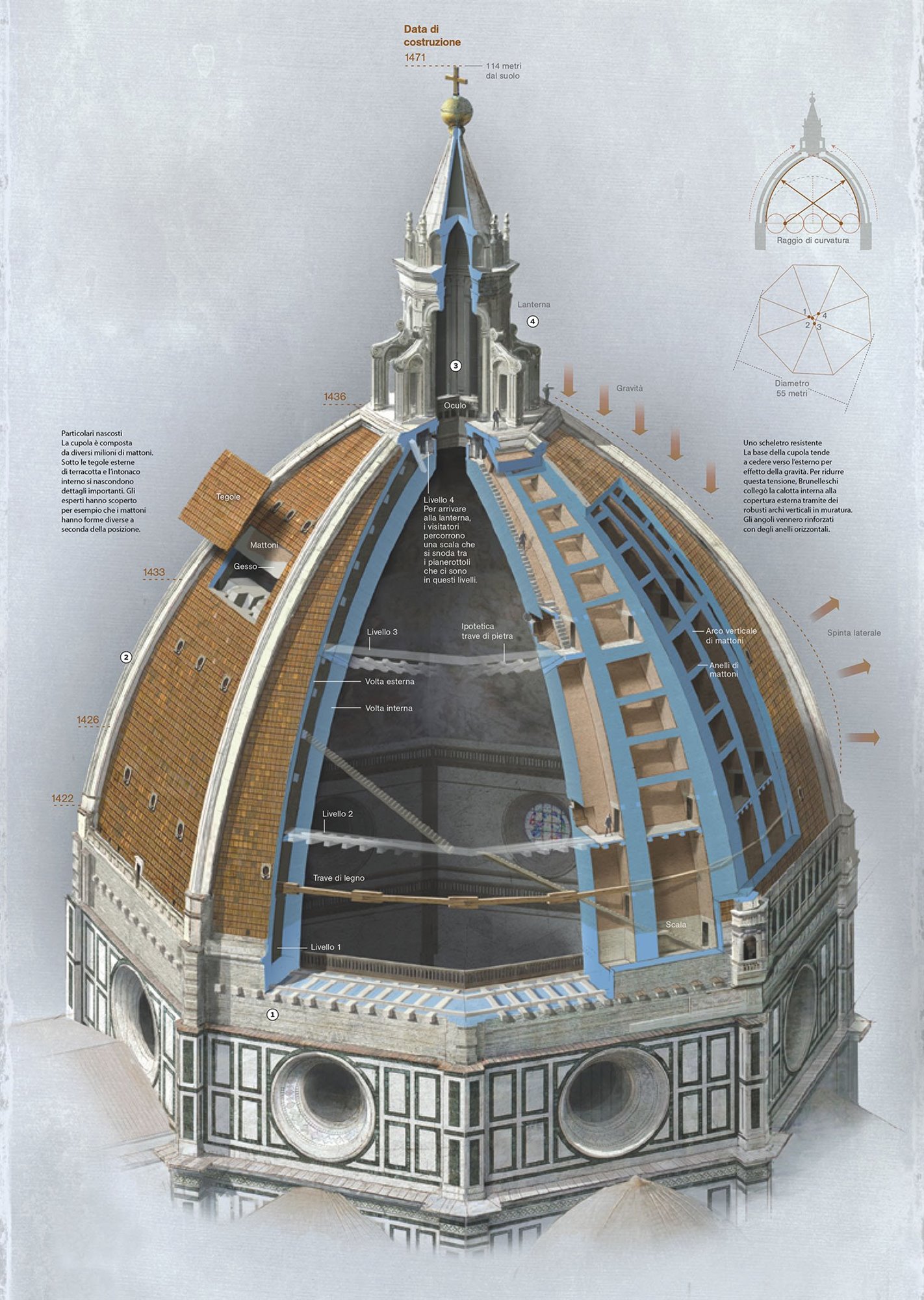
The Dome of Florence Cathedral represents one of the greatest mysteries of Renaissance architecture. When Filippo Brunelleschi won the competition for its construction in 1418, he refused to reveal how he would build the largest dome ever constructed without supporting centerings. The challenge was impressive: a dome 45.5 meters in diameter, which had to rise to a height of 116 meters, built with bricks that weighed a total of 37,000 tons.
Brunelleschi developed revolutionary techniques, including an innovative system of bricks arranged in a herringbone pattern that allowed the dome to support itself during construction. He also invented extraordinary construction machines, some of which have not been fully understood even today. His material lifting system, which allowed oxen to lift heavy loads by walking both forward and backward, was so innovative that it was protected by a patent, the first documented in history.
The construction required 16 years of work (1420-1436) and involved hundreds of workers working at dizzying heights. Brunelleschi had a kitchen installed on the dome itself to prevent workers from wasting time going down for lunch. He also designed a communication system based on bells and flags to coordinate work between ground and dome.
One of the most mysterious features concerns the geometric precision of the construction: the dome is perfectly octagonal and its proportions follow mathematical rules so precise that scholars still debate how Brunelleschi could have achieved them with the tools of the time. Some secrets of its construction, such as the exact system used for the alignment of the bricks, remain unresolved despite centuries of study.
